Subsea Lifting Operations: Understanding Dynamic Loads, Splash-Zone Hazards and Seabed Breakout
Explore the critical risks of subsea lifting operations, including dynamic loading, splash-zone hazards, seabed suction (Golden Jump), and heave compensation. Learn how these factors affect offshore crane safety.
Introduction
Subsea lifting operations are among the most demanding activities performed by offshore cranes. Unlike conventional deck lifting, subsea operations involve changing environmental forces, hydrodynamic effects, vessel motion, and complex interactions between the lifting equipment, suspended load, and seabed.
A load that appears stable while suspended in open water may experience significantly different forces when passing through the sea surface or separating from the seabed.
Two particularly critical phases are the transition through the splash zone and the initial breakout of a load from soft seabed sediments.
Understanding these phenomena is essential for safe lift planning, crane operation, and effective communication between offshore teams.
1. Understanding the Subsea Lifting Environment
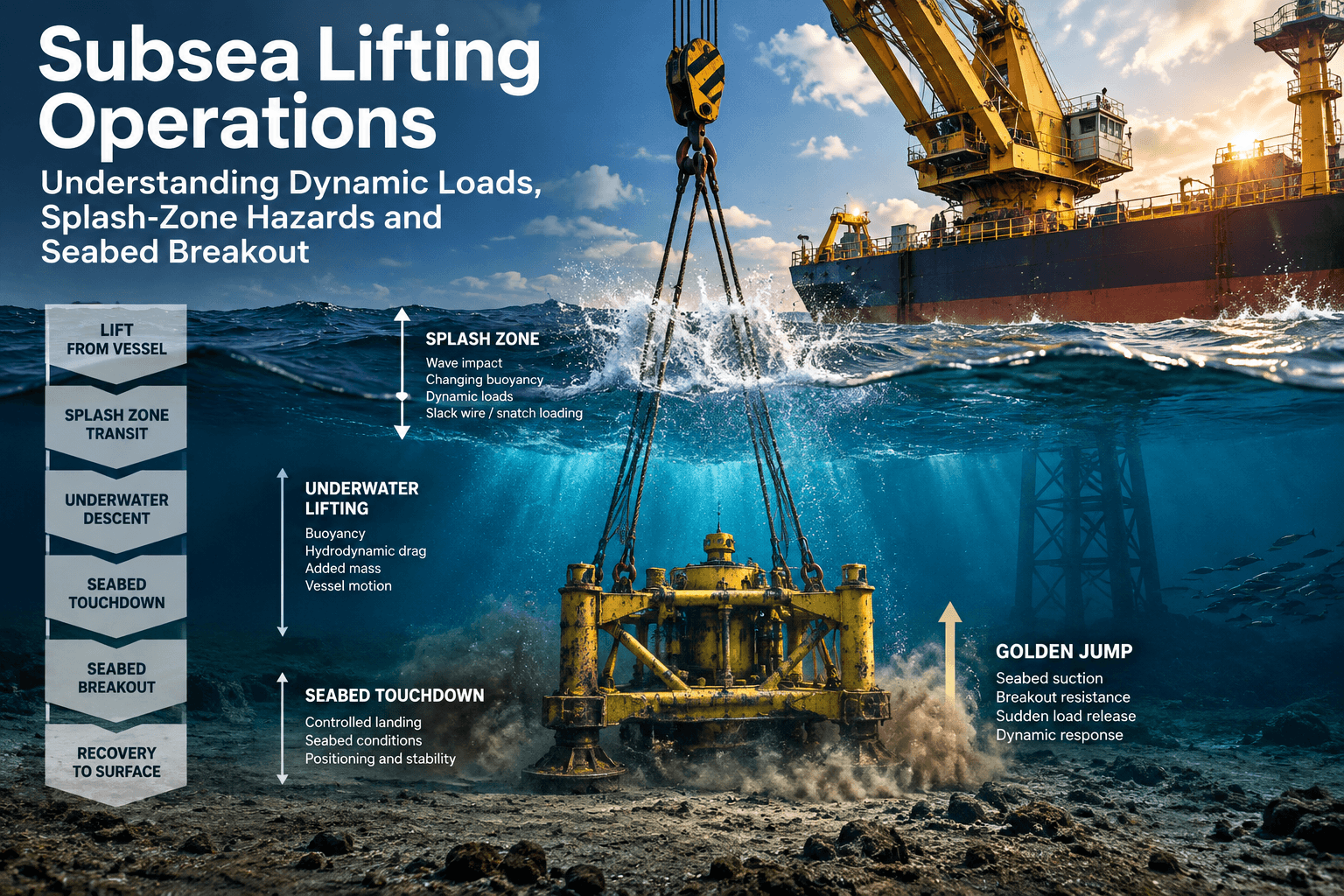
A subsea lifting operation typically involves several distinct phases:
Lifting the load from the vessel or offshore installation.
Lowering the load through the air–water interface.
Controlling the load during underwater descent.
Positioning and landing the load on the seabed.
Recovering the load, when required, including seabed breakout and retrieval through the splash zone.
Each phase introduces different loading conditions.
Above the water, the crane primarily supports the gravitational load together with the dynamic effects associated with crane and vessel movement.
As the load enters the water, buoyancy, hydrodynamic drag, added mass, and wave-induced forces become relevant.
At greater depths, the suspended system may also be influenced by current, lifting-line weight, cable geometry, and vessel motion transmitted through the lifting arrangement.
At the seabed, contact forces, sediment interaction, and potential suction effects introduce another set of hazards.
A safe operation therefore requires more than simply checking the load weight against the crane’s nominal lifting capacity.
2. The Splash Zone: A Critical Transition
The splash zone is the region around the sea surface where a suspended load interacts with waves and repeatedly changing immersion conditions.
During lowering or recovery, the load may experience rapid variations in buoyancy and hydrodynamic forces.
Depending on its geometry and motion, wave impact can generate substantial transient loads.
One particularly dangerous condition is the development of slack wire followed by sudden re-tensioning.
When tension is lost and subsequently restored, the resulting snatch load may be significantly greater than the force associated with the load’s apparent submerged weight.
This is especially relevant when the crane is installed on a moving vessel.
The combination of vessel heave, load motion, and wave interaction can create complex relative movement between the crane tip and the suspended object.
The operational challenge is to maintain the load within the approved lifting envelope while avoiding uncontrolled changes in line tension.
Splash-zone operations should therefore be evaluated using the appropriate engineering assessment, crane documentation, environmental limitations, and project-specific procedures.
3. Dynamic Loading Below the Surface
Once the load is fully submerged, the hydrodynamic conditions change.
Buoyancy reduces the net gravitational force transmitted through the lifting system, while drag and added-mass effects influence its response to acceleration and relative water movement.
For a simplified fully submerged object, the net gravitational and buoyancy contribution can be expressed as:
F = W − B
Where:
W is the gravitational force acting on the load.
B is the buoyancy force.
This simplified expression does not represent the total dynamic line tension.
Additional forces may arise from acceleration, hydrodynamic drag, current, lifting-line behaviour, and vessel motion.
The weight and hydrodynamic behaviour of the lifting line itself may become increasingly important as operating depth increases.
The lifting arrangement must therefore be assessed as a complete system rather than treating the load as an isolated object.
4. Seabed Touchdown and Load Stability
Seabed touchdown represents another critical transition.
As the load approaches the seabed, the operating team must control its position, orientation, and descent in accordance with the approved installation procedure.
Unexpected contact, lateral movement, or excessive landing velocity can damage the load or subsea infrastructure.
The characteristics of the seabed are particularly important.
Soft sediment, cohesive clay, and uneven terrain can influence how the load settles and how easily it can subsequently be recovered.
For some structures, seabed interaction becomes a significant engineering consideration even after the lifting wire has been partially unloaded.
Communication between the crane operator, vessel bridge, lifting supervisor, and ROV team is essential during this phase.
5. The Golden Jump Effect: Seabed Suction and Sudden Breakout
One of the less obvious hazards during subsea recovery is the sudden release of a load from soft seabed sediments.
In OffshoreTrainer learning material, this phenomenon is described as the Golden Jump effect.
In broader technical terminology, it relates to seabed suction, breakout resistance, and the sudden release of stored elastic energy.
When a heavy subsea structure rests on soft mud or cohesive sediment, suction and soil adhesion can increase the force required to initiate recovery.
As the crane applies tension, the lifting wire stretches and the crane structure may deform elastically.
Energy accumulates within the lifting system.
When the load finally separates from the seabed, the resisting force can disappear rapidly.
The release of stored energy may cause sudden upward acceleration and dynamic oscillation.
Structures with large, relatively flat bottom surfaces, including mud mats, subsea templates, and certain frames, can be particularly susceptible to suction-related breakout resistance.
The danger is not simply the additional force required to separate the load from the seabed.
It is also the dynamic response of the crane–wire–load system when that resistance is suddenly removed.
For this reason, seabed breakout should be assessed as a distinct lifting phase.
The recovery procedure should address expected breakout resistance, system response, permissible loading, and the conditions requiring the operation to be stopped and reassessed.
6. Heave Compensation: Capabilities and Limitations
Heave compensation systems can reduce the influence of vessel motion during subsea lifting.
Passive Heave Compensation (PHC) uses mechanical or hydraulic arrangements to reduce the transmission of vessel movement into the suspended load.
Active Heave Compensation (AHC) uses controlled winch movement to counteract vessel heave and improve load-position control.
These systems can substantially improve operational performance, but they do not eliminate all dynamic risks.
Their effectiveness depends on equipment capability, operating conditions, control-system behaviour, and the characteristics of the suspended load.
During rapid seabed breakout or severe vessel motion, compensation systems may approach their stroke, speed, or force limitations.
A loss of effective compensation during a critical phase can increase the risk of unexpected dynamic loading.
The use of AHC or PHC must therefore remain within the manufacturer’s approved limits and the project-specific lifting procedure.
7. The Role of the Crane Operator and Offshore Team
Safe subsea lifting requires coordinated decision-making across several disciplines.
The crane operator must understand the relevant crane operating limits and recognise abnormal changes in load behaviour.
The lifting supervisor must ensure that the operation follows the approved lifting plan.
The vessel bridge provides essential information about vessel position, heading, and environmental conditions.
The ROV team may provide critical visual information during subsea positioning, touchdown, and breakout.
Where applicable, engineers establish the loading assumptions, environmental limits, and acceptable operating envelope.
A key operational principle is that unexpected load behaviour should trigger reassessment rather than an attempt to overcome resistance through continued hoisting.
An unexplained increase in line tension does not, by itself, establish the cause of resistance.
The load may be affected by seabed suction, obstruction, entanglement, or another condition requiring investigation.
Clear communication and predefined stop-work criteria are essential.
8. Why Subsea Lifting Requires a Different Approach
Conventional lifting assessments frequently begin with load weight, lifting radius, and equipment capacity.
These parameters remain essential offshore, but subsea operations require additional consideration of environmental and hydrodynamic effects.
A complete assessment may need to address:
Changing buoyancy and hydrodynamic loading.
Vessel motion and relative velocity.
Dynamic line tension.
Splash-zone entry and exit.
Submerged lifting-line weight and drag.
Seabed touchdown conditions.
Soil suction and breakout resistance.
Heave-compensation capability.
Environmental limits and contingency procedures.
The objective is not to introduce unnecessary complexity into routine crane operation.
It is to ensure that the risks specific to each subsea lifting phase are understood, evaluated, and controlled.
Conclusion
Subsea lifting is not simply conventional lifting performed underwater.
The transition through the splash zone, movement through the water column, seabed touchdown, and subsequent breakout can expose the crane and lifting system to substantially different forces.
The splash zone presents risks associated with changing immersion, wave interaction, and sudden variations in line tension.
Seabed breakout introduces another critical hazard: the potential release of stored energy when a load separates from soft sediments.
Heave compensation can reduce vessel-motion effects, but it cannot replace sound engineering or eliminate the need for operational discipline.
Understanding these interactions helps offshore teams recognise when an apparently controlled lift may be approaching a critical condition.
Successful subsea lifting depends not only on the crane’s capacity, but on understanding how the load behaves throughout every phase of the operation.
Technical note: This article is intended for professional education and discussion. It does not replace approved lifting plans, crane operating manuals, manufacturer instructions, or project-specific engineering assessments.
Suggested technical references for editorial verification: DNV-ST-N001 Marine Operations and Marine Warranty; DNV-ST-0378 Offshore and Platform Lifting Appliances; applicable IMCA guidance on lifting operations; equipment-specific subsea lifting and heave-compensation documentation.