Offshore Crane Load Limits: Why Rated Capacity Is Only Part of the Safety Equation
Offshore crane rated capacity does not automatically guarantee a safe lift. Explore SWL and WLL, load chart limitations, dynamic amplification factors, vessel motion, environmental restrictions, and the critical role of operator decision-making in offshore lifting safety.

Offshore Crane Load Limits: Why Rated Capacity Is Only Part of the Safety Equation
Understanding Safe Working Load, Load Charts, Dynamic Amplification, Environmental Limits, and Operator Decision-Making in Offshore Lifting Operations
Author: Igor Okunev
Publication: OffshoreTrainer — Technical Insights
Category: Offshore Crane Operations & Lifting Safety
Published: October 2026
1. Introduction: Rated Capacity Is Not a Guarantee of a Safe Lift
One of the most persistent misconceptions in offshore crane operations is that a lift is safe simply because the weight of the load is below the crane’s rated capacity.
In reality, the rated capacity displayed on a crane’s load chart represents an allowable lifting capacity under a defined set of conditions. It is not an unconditional guarantee that a particular lifting operation can be performed safely.
Offshore lifting operations are influenced by numerous variables, including crane configuration, operating radius, vessel motion, environmental conditions, lifting gear capacity, dynamic loading, and the movement of the receiving or supplying vessel.
A crane may be rated to lift 50 tonnes at a particular radius, yet that rating may not be applicable to an offboard lift involving a moving supply vessel, significant wave action, or operating conditions outside the manufacturer’s approved limits.
The critical distinction is between the crane’s rated capacity and the allowable capacity for the actual lifting operation.
Understanding this distinction is fundamental to safe offshore crane operations.
2. Safe Working Load (SWL) and Working Load Limit (WLL)
The terms Safe Working Load (SWL) and Working Load Limit (WLL) are frequently encountered in lifting operations. Although they are sometimes used interchangeably in everyday offshore terminology, their precise application depends on the equipment, manufacturer, applicable standard, and regulatory framework.
2.1 Safe Working Load (SWL)
SWL is a traditional term used to describe the maximum load that lifting equipment is permitted to handle under specified conditions.
In marine operations, the term may appear in crane documentation, equipment markings, lifting appliance certificates, and vessel procedures.
However, an SWL marking must not be interpreted independently of the conditions under which it applies.
For a crane, permissible capacity may change with:
Operating radius.
Boom configuration.
Operating mode.
Vessel inclination.
Environmental conditions.
Applicable dynamic loading assumptions.
Consequently, a crane’s marked SWL does not necessarily represent its allowable capacity throughout its entire operating envelope.
2.2 Working Load Limit (WLL)
WLL is commonly used for lifting accessories and components, including:
Wire rope slings.
Chain slings.
Shackles.
Hooks.
Lifting beams.
Other certified lifting accessories.
The WLL represents the maximum working load assigned to the equipment by its manufacturer or another competent authority under defined conditions.
The applicable WLL may be affected by the configuration in which the accessory is used.
For example, a sling assembly may have different permitted capacities depending on its lifting arrangement, sling angles, and manufacturer instructions.
2.3 Why the Distinction Matters
Neither an SWL nor a WLL marking should be treated as a universal statement of safe capacity.
For any lifting operation, the relevant equipment ratings must be considered together with the actual lifting configuration and operating conditions.
The allowable capacity of a lifting system is constrained by its applicable ratings, configuration, operating conditions, and any additional restrictions imposed by the approved lifting procedure.
3. Understanding Offshore Crane Load Charts
A crane load chart is one of the primary technical references used to determine the allowable lifting capacity of a crane.
However, interpreting a load chart requires more than identifying a weight and checking the corresponding radius.
3.1 Operating Radius
The operating radius is generally the horizontal distance between the crane’s axis of rotation and the vertical line through the suspended load, as defined by the crane manufacturer.
As the radius increases, the allowable lifting capacity often decreases because of increasing overturning moments and structural loading.
For illustration, a hypothetical crane might have the following ratings:
Operating Radius
Rated Capacity
10 m
50 tonnes
15 m
35 tonnes
20 m
25 tonnes
25 m
18 tonnes
Illustrative values only. These figures do not represent a real crane or an approved load chart.
A load weighing 20 tonnes could fall within the hypothetical crane’s rating at a radius of 20 metres but exceed its rating at 25 metres.
The operator must therefore consider the entire planned lifting path, including any increase in radius during the operation.
3.2 Boom Configuration
Crane capacity can depend on:
Boom length.
Boom angle.
Reeving arrangement.
Main or auxiliary hoist selection.
Hook block and lifting equipment configuration.
Manufacturer-defined operating mode.
The relevant load chart must correspond to the actual crane configuration.
3.3 Gross Load and Net Payload
Another important consideration is whether the applicable load chart expresses gross rated load or net payload.
Depending on the manufacturer’s documentation, the operator may need to account for:
Hook block weight.
Slings and shackles.
Lifting beams or spreader bars.
Other suspended lifting accessories.
These components can contribute to the total load imposed on the crane.
The method of accounting for them must follow the manufacturer’s instructions and the approved lift plan.
A lifting operation must not be approved solely by comparing the cargo weight with the displayed crane capacity.
4. Dynamic Amplification Factor (DAF)
Dynamic loading is one of the most important differences between lifting operations in relatively stable conditions and offshore lifting operations involving vessel motion.
When a load is lifted from or transferred to a moving vessel, the crane may experience forces that exceed those associated with the load’s static weight.
These additional forces can arise from:
Heave motion.
Roll and pitch.
Relative movement between vessels.
Load acceleration and deceleration.
Sudden changes in line tension.
Slack-line conditions followed by re-tensioning.
Load impact during landing or pickup.
4.1 What Is Dynamic Amplification?
Dynamic Amplification Factor, or DAF, is used in certain engineering calculations to represent the relationship between a dynamic load effect and a corresponding static load effect.
A simplified illustrative expression is:
Dynamic Load Effect = Static Load Effect × DAF
This expression is useful for explaining the concept, but it is not a complete offshore lifting calculation.
The applicable calculation method depends on the crane design, lifting operation, governing standard, and approved engineering methodology.
4.2 Illustrative Example
Consider a suspended load with a static mass equivalent of 20 tonnes.
If an engineering assessment applies a hypothetical DAF of 1.30 to the relevant static load effect, the corresponding amplified load effect would be equivalent to:
20 × 1.30 = 26 tonnes.
This example demonstrates that a load’s dynamic effect may exceed its static equivalent.
However, a DAF of 1.30 must not be assumed to apply to any particular offshore lift.
Furthermore, a calculated dynamic load effect cannot automatically be compared with an arbitrary crane load-chart value. The comparison must use the capacity definition and design assumptions applicable to that crane and operating mode.
4.3 The Danger of Using a Universal DAF
Dynamic loading depends on factors such as:
Vessel motion characteristics.
Wave height and period.
Crane position on the vessel or installation.
Load mass and geometry.
Hoisting speed.
Relative motion between lifting and receiving points.
Crane and rigging system characteristics.
Different lifting scenarios may require different engineering approaches.
Operators must therefore use the approved crane documentation, lift plan, and relevant operational procedures rather than selecting an arbitrary dynamic factor.
5. Onboard and Offboard Lifting Operations
The distinction between onboard and offboard lifting is particularly important in offshore crane operations.
5.1 Onboard Lifting
Onboard lifting generally involves moving a load between locations on the same vessel or installation, subject to the definitions used in the applicable crane documentation.
Where the crane and load originate on the same moving structure, some aspects of their motion may be correlated.
However, this does not eliminate dynamic effects or other hazards.
The applicable crane operating mode and limitations must still be observed.
5.2 Offboard Lifting
Offboard lifting may involve transferring loads between:
An offshore installation and a supply vessel.
Two vessels.
A floating vessel and another offshore structure.
A crane vessel and an external lifting location.
These operations can introduce significant relative movement between the crane and the load pickup or landing point.
For example, during a transfer from an offshore installation to a supply vessel, the receiving vessel may experience heave, roll, and pitch.
The resulting relative motion can affect:
Hook-to-deck clearance.
Load landing conditions.
Crane line tension.
Load stability.
Personnel exposure.
The ability to maintain control of the suspended load.
5.3 Load Pickup from a Moving Vessel
A particularly hazardous stage of an offboard operation is the initial pickup from a moving deck.
If the lifting line becomes slack and is subsequently re-tensioned as the vessel moves, substantial transient loading may occur.
Similarly, attempting to lift a load while it remains restrained, snagged, or otherwise connected to the vessel can create unexpected forces.
The operator must not attempt to compensate for an uncontrolled situation by increasing hoisting speed or applying additional crane force.
The operation must remain within the approved procedure and crane operating limits.
6. Environmental Operating Limits
Environmental conditions directly affect the safety and feasibility of offshore lifting operations.
The most relevant factors may include wind, sea state, vessel motion, visibility, and other conditions specified in the crane’s operating documentation.
6.1 Wind
Wind can influence a suspended load through aerodynamic forces.
The magnitude of this effect depends on factors including:
Wind speed.
Exposed surface area.
Load shape.
Load orientation.
Height above the deck.
Local wind conditions.
A relatively light load with a large exposed surface area may be more difficult to control than a heavier, compact load.
Wind limitations must therefore be assessed in accordance with the crane manufacturer’s instructions and the approved lifting procedure.
6.2 Sea State and Vessel Motion
Significant wave height alone does not provide a complete description of the motion affecting a lifting operation.
Wave period, direction, vessel response, and the relative movement of the crane and receiving vessel can be equally important.
Two sea states with similar wave heights may produce different vessel motions.
The relevant operational decision must therefore consider the environmental parameters and vessel-motion limits applicable to the specific operation.
6.3 List and Trim
Crane capacity and stability can be affected by vessel inclination.
The crane manufacturer’s documentation may specify maximum permissible list and trim angles or other vessel-attitude restrictions.
Operations outside these limits must not proceed without an appropriate approved engineering basis and authorization.
6.4 Visibility and Communication
Poor visibility, inadequate deck lighting, and unreliable communication can make an otherwise technically permissible lift unsafe.
The operator must be able to maintain the required situational awareness, directly or through the approved signaling and communication arrangements.
If communication with the designated banksman or other essential personnel is lost, the operation should be brought to a safe condition and suspended until effective communication is restored.
7. Operator Decision-Making: Knowing When to Stop
A crane operator’s responsibility extends beyond maintaining the load within the numerical limits shown on a load chart.
The operator must continuously assess whether the conditions required for the approved lifting operation remain satisfied.
A load can be within the crane’s nominal capacity while the operation itself has become unsafe.
7.1 Conditions Requiring Suspension of Operations
Depending on the circumstances and approved procedures, lifting operations must be stopped or suspended when:
1. Environmental limits are exceeded.
Wind, vessel motion, or other conditions exceed the applicable operational restrictions.
2. Uncontrolled load movement develops.
The suspended load begins swinging or rotating in a manner that cannot be controlled within the approved procedure.
3. Communication is lost.
The operator can no longer maintain the required communication with the lifting team.
4. The load becomes snagged or restrained.
Unexpected resistance or abnormal line tension indicates that the load may be connected to another object.
5. The actual load condition differs from the lift plan.
The load weight, centre of gravity, rigging arrangement, or lifting configuration differs materially from the approved assumptions.
6. Crane safety systems indicate a problem.
An alarm, overload indication, equipment malfunction, or other safety-related condition requires action under the manufacturer’s procedures.
7. Personnel enter an unsafe position.
Personnel are exposed to a suspended load, potential crush points, or another uncontrolled lifting hazard.
7.2 Stop-Work Authority
A competent offshore lifting team must understand that stopping an operation is a safety decision, not a failure of performance.
The operator should not be pressured to continue a lift merely because the crane appears to have sufficient nominal capacity.
Operational decisions must be based on actual conditions, approved procedures, and applicable equipment limitations.
The ability to recognize when a lift should not proceed is a fundamental element of professional crane operator competency.
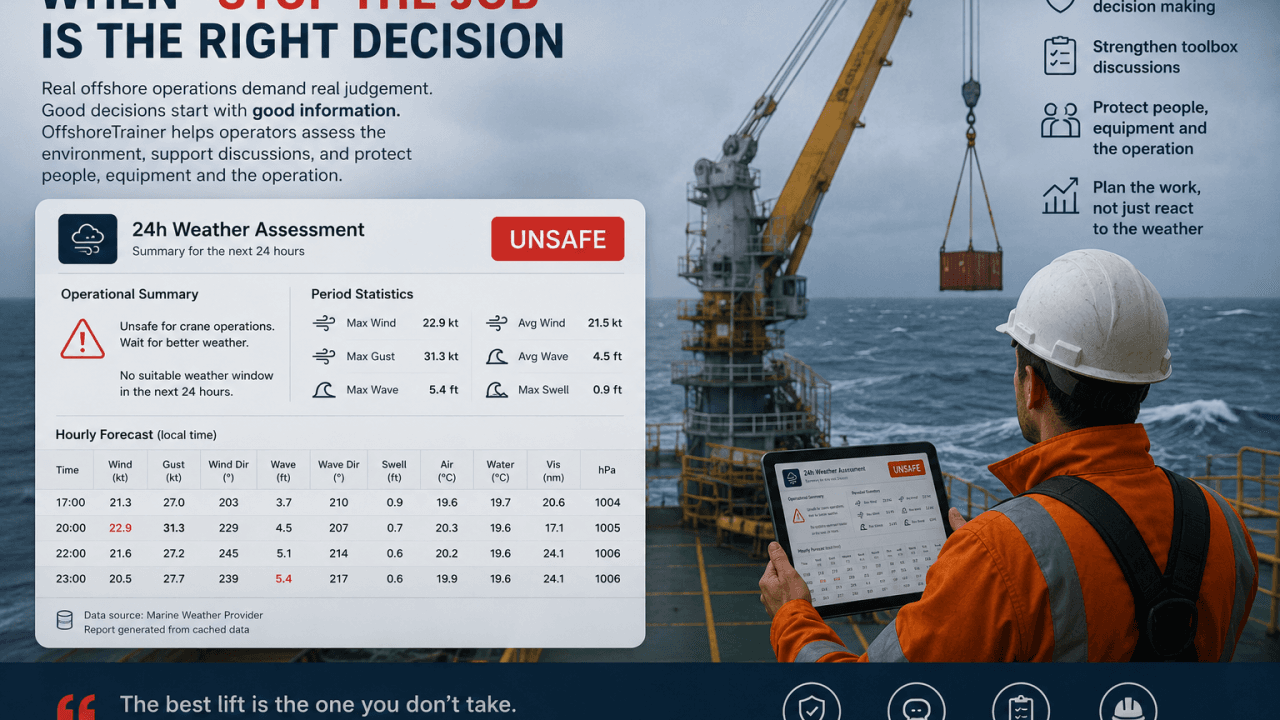
8. Practical Example: A Load Within Capacity but Outside Safe Operating Conditions
Consider the following hypothetical scenario.
An offshore crane is preparing to transfer a 15-tonne cargo unit from an offshore installation to a supply vessel.
The crane’s applicable load chart indicates a rated capacity of 20 tonnes at the planned radius.
At first glance, the load appears to be within the crane’s capacity.
However, during preparation:
The supply vessel begins experiencing increased heave and roll.
Relative motion between the crane hook and receiving deck becomes more pronounced.
Wind conditions deteriorate.
The lifting team reports difficulty maintaining the required landing-zone clearance.
The load remains below the nominal chart capacity.
Nevertheless, the operation may no longer satisfy the conditions assumed by the approved lifting plan.
The correct response is not to rely on the apparent five-tonne capacity margin.
The lifting team must assess the changed conditions against the applicable operating limits and suspend the operation if those limits or other safety requirements cannot be maintained.
This example illustrates a central principle of offshore crane operations:
A numerical capacity margin does not compensate for an unacceptable operational condition.
9. The Importance of Competency and Continuous Training
Understanding crane capacity requires more than memorizing a load chart.
A competent offshore crane operator must understand how technical limitations interact with real operating conditions.
This includes knowledge of:
Load chart interpretation.
Lifting equipment limitations.
Dynamic loading.
Environmental restrictions.
Vessel motion.
Rigging configurations.
Operational communication.
Emergency and stop-work procedures.
Formal certification and practical experience are important elements of competency, but maintaining technical knowledge throughout a professional career is equally important.
Digital training systems, structured knowledge assessments, and access to technical reference materials can support continuing professional development.
Such tools should complement, rather than replace, practical assessment, manufacturer-specific training, approved procedures, and supervision by competent personnel.
10. Conclusion: Capacity Is a Condition, Not a Guarantee
Offshore crane operations require a broader understanding of lifting capacity than simply comparing the weight of a load with a number on a crane’s load chart.
Safe lifting depends on the interaction of several factors:
The crane’s applicable rated capacity.
Its actual configuration and operating radius.
The capacity and arrangement of lifting accessories.
Dynamic loading assumptions.
Environmental conditions.
Vessel motion and relative movement.
The approved lifting plan.
The competence and judgment of the lifting team.
The crane’s rated capacity establishes an important technical limit, but it does not independently determine whether a particular operation is safe.
A successful offshore lifting operation requires that the crane, lifting equipment, load, environmental conditions, and operational arrangements remain within their applicable limits throughout the lift.
The fundamental principle is straightforward: a load being within the crane’s rated capacity does not necessarily mean the lifting operation is safe.
Professional competence means understanding both what the crane is technically capable of lifting and the conditions under which that capability can be used safely.
Technical References and Further Reading
The following publications provide relevant technical and regulatory context. Their applicability depends on the equipment, jurisdiction, and nature of the lifting operation.
International Organization for Standardization (ISO). ISO 12480-1 — Cranes — Safe Use — Part 1: General.
American Petroleum Institute (API). API Specification 2C — Offshore Pedestal-mounted Cranes.
British Standards Institution (BSI). BS 7121 series — Code of Practice for Safe Use of Cranes.
UK Health and Safety Executive (HSE). Lifting Operations and Lifting Equipment Regulations 1998 (LOLER).
Crane Manufacturer Documentation. Approved load charts, operating manuals, environmental restrictions, and crane-specific lifting procedures.
Reference editions and applicable clauses should be verified against the standards governing the specific crane and operation.
Technical Disclaimer
This article is provided for professional education and general technical awareness.
It does not constitute an approved lifting plan, engineering calculation, operational authorization, or substitute for manufacturer instructions.
All lifting operations must comply with the applicable crane documentation, vessel procedures, regulatory requirements, and approved operational limitations.
The numerical examples presented are hypothetical and must not be used to determine the safe capacity of actual lifting equipment.
Author: Igor Okunev View on LinkedIn