Finding a Better Heading Before the Lift: Taking OffshoreTrainer’s Heading Adviser Into Real Operations
How OffshoreTrainer’s Heading Adviser connects weather, vessel heading and sea-state conditions to support safer offshore lifting decisions in real operations.
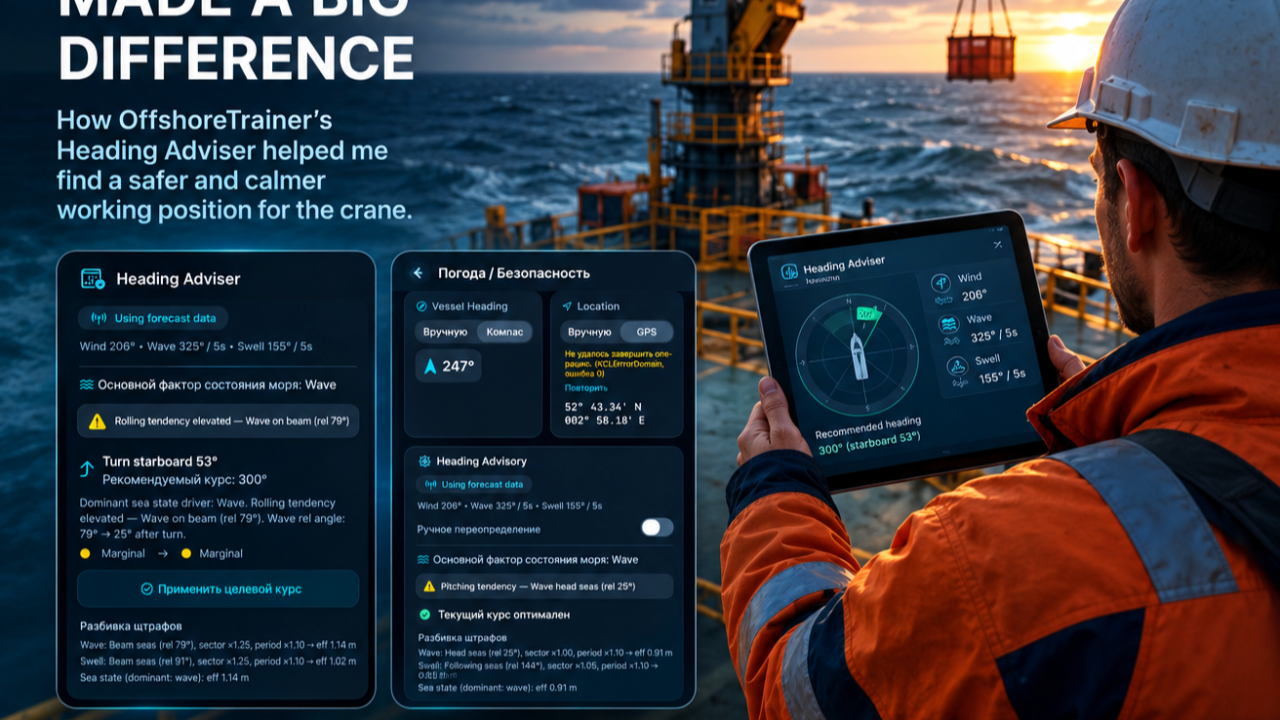
But numbers considered individually do not always tell the crane operator what the crane is actually going to feel. A sea state that looks manageable on paper can become uncomfortable when its direction relative to the vessel creates an unfavourable motion pattern. The crane begins moving with the vessel, the hook starts swinging, and the operator spends unnecessary effort trying to control and damp that movement. This is one of the reasons I developed Heading Adviser for OffshoreTrainer. And after using it offshore on multiple occasions, I am beginning to see something much more interesting than a successful calculation. I am beginning to see a repeatable pattern between the heading recommended by the Adviser and the vessel orientation that I experience as favourable from the crane.
A Real Operational Example
Recently, before a toolbox talk for a planned offshore crane operation, I checked the environmental situation using OffshoreTrainer.
I wasn’t simply asking:
“Is the weather good or bad?”
I wanted to answer a more operationally useful question:
“Given the present environmental conditions, is our current vessel orientation the best one for the crane operation, or could another heading reduce the effect of the sea state?”
Heading Adviser evaluated the situation and suggested an adjustment of approximately:
20° to port.
That was useful because it gave me a specific heading recommendation to consider rather than simply experimenting with different vessel orientations.
I discussed the recommendation with the bridge team.
The bridge evaluated my request and kindly provided the requested heading.
Then I raised the crane.
From the crane operator’s perspective, the resulting orientation was considerably more favourable for the work.
Instead of spending my attention continuously fighting and damping unnecessary crane swing, I was able to raise and operate the crane much more calmly.
But the most interesting part for me wasn’t simply that it worked on that occasion.
I have observed the same relationship before.
One Successful Test Is Interesting. A Pattern Is More Important.
As the person developing OffshoreTrainer, I have to be careful about the conclusions I draw from my own operational experience.
One successful result does not prove that an algorithm is universally correct.
And Heading Adviser should never be presented as something that automatically determines how a vessel must be positioned.
But when the same thing begins happening repeatedly, it deserves attention.
On several occasions now, I have compared the recommendation produced by Heading Adviser with what I subsequently experienced during the actual crane operation.
And I am beginning to see a pattern:
the heading identified by the Adviser corresponds closely with an orientation that feels operationally more favourable from the crane.
For me, this is an important stage in the development of the feature.
It is moving from:
theoretical calculation → software implementation → field observation.
The next step is systematic field validation.
Why Heading Matters to the Crane Operator
For crane operations, environmental conditions are not simply a collection of maximum values.
Direction matters.
The relationship between the environmental forces and the vessel matters.
And the resulting vessel motion matters.
A crane operator experiences that relationship directly.
When the vessel is moving unfavourably, that movement is transmitted into the crane system and suspended load. The operator may find himself spending significantly more attention controlling swing instead of concentrating on the actual lifting task.
Changing the vessel heading can change that relationship.
Sometimes a relatively small adjustment may provide a much more favourable orientation.
That does not mean simply turning the vessel until the crane operator feels comfortable.
The vessel has its own operational constraints.
The bridge has to consider navigation, positioning requirements, DP limitations where applicable, surrounding infrastructure, other vessels, the lift plan and many other factors that the crane operator may not control.
That is why Heading Adviser is not intended to issue commands to the bridge.
Its purpose is different.
From Guesswork to a Better Conversation
Without a decision-support tool, the conversation might begin like this:
“The vessel is moving too much. Can we try another heading?”
There is nothing inherently wrong with that request. Experienced crane operators and bridge teams have been solving these problems professionally for decades.
But I believe software can make the discussion more structured.
Instead, the crane operator can approach the bridge with something closer to:
“Based on the current environmental conditions, the assessment indicates that approximately 20° to port may provide a more favourable orientation for the crane operation. Can we evaluate that heading?”
That is a different conversation. The software provides an additional reference. The crane operator provides operational experience. The bridge provides navigational and vessel expertise. And the final decision remains with the competent people responsible for the operation. That is exactly how I believe professional decision-support software should work.
The Crane Operator and Bridge Are Looking at the Same Problem From Different Places
There is another lesson from this experience that has nothing to do with software.
Good cooperation between the crane operator and the bridge team matters enormously.
The crane operator knows what is happening at the controls.
We can feel when vessel movement is creating unnecessary difficulty with the crane. We see what is happening with the hook and suspended load. We understand when we are spending too much effort controlling movement that might potentially be reduced through a different vessel orientation.
The bridge sees the situation from another perspective.
They understand what the vessel is doing and what heading changes are actually possible within the operational situation. Neither perspective should replace the other. They should complement each other. In my recent case, that cooperation was straightforward:
Heading Adviser produced a recommendation → I discussed it with the bridge → the bridge evaluated the request → the requested heading was provided → I evaluated the result from the crane.
And the resulting working condition was favourable.
That is exactly the type of human–technology cooperation I want OffshoreTrainer to support.
What Heading Adviser Is — and What It Is Not
This distinction is important.
Heading Adviser does not navigate the vessel.
It does not replace the Master.
It does not replace the bridge team.
It does not replace DP or vessel systems.
It does not override the lift plan, company procedures, operational limitations or professional judgement.
And it certainly does not guarantee that a suggested heading can or should be adopted.
A vessel may simply be unable to provide the suggested orientation because of navigational, operational or positioning constraints.
Heading Adviser is a decision-support tool.
Its job is to analyse the available environmental information and help the operator identify an orientation worth evaluating.
The bridge then determines whether that recommendation is feasible.
The crane operator then observes whether the resulting conditions actually improve the operation.
That distinction is essential.
I do not want OffshoreTrainer making professional decisions instead of professionals.
I want it to help professionals make better-informed decisions.
Why This Could Matter to Crane Operators
For an offshore crane operator, reducing unnecessary crane movement isn’t merely about making the job more comfortable.
Operator attention is a limited resource.
If a large part of that attention is being spent continuously compensating for avoidable movement and damping swing, less attention is available for everything else happening during the lift.
If a more favourable vessel orientation can reduce that unnecessary workload, the operator can concentrate more effectively on the operation itself.
There is also a communication benefit.
A specific recommendation gives the operator something concrete to discuss with the bridge rather than relying entirely on trial and error.
And sometimes the result of the analysis may be equally valuable in the opposite direction:
there may be no useful heading adjustment capable of making the operation acceptable.
In that situation, the right answer may simply be to wait.
A good decision-support system should be useful for both conclusions.
Why This Could Matter to Offshore Companies
There is a broader operational question here as well.
Weather downtime offshore is expensive.
But attempting to work in unnecessarily difficult conditions can also be expensive — and potentially much worse.
Between those two extremes there is an important operational question:
Are we making the best use of the environmental conditions that are actually available?
Sometimes the answer may be to stop the operation.
Sometimes it may be to wait for a better weather window.
And sometimes there may be an opportunity to improve the working condition through a relatively small operational adjustment.
If software can help identify those opportunities earlier, before the operation begins, it could support better toolbox discussions and better coordination between crane operators and bridge teams.
That potentially means better preparation, more structured decision-making and more effective use of available operating windows.
But those benefits need to be demonstrated with data rather than assumed.
From Field Observation to Field Validation
This is where the Heading Adviser project becomes particularly interesting to me.
I now have repeated real-world observations suggesting that its recommendations correspond with favourable crane operating conditions.
That is encouraging.
But the engineering response to an encouraging observation should not be:
“It works.”
It should be:
“Let’s measure it.”
Going forward, I want to document these situations systematically.
For each suitable operation, that means recording information such as the initial vessel heading, environmental conditions, Heading Adviser recommendation, heading actually provided by the bridge, and the operational result observed from the crane.
Over enough operations, those observations can become a meaningful field-validation dataset.
Then we can start asking much stronger questions.
How often does the recommended heading correspond with the heading preferred operationally?
How large are the typical recommended adjustments?
Under what combinations of wave, swell and wind does the recommendation provide the greatest practical benefit?
When does changing heading provide little or no improvement?
Where are the limitations of the model?
Those questions are much more valuable to me than simply saying that an application feature “works.”
Because offshore professionals don’t need another impressive-looking screen.
They need tools they can trust.
And trust has to be earned through real operational experience.
From Training Tool to Operational Decision Support
OffshoreTrainer originally grew from a training concept.
Teach.
Practice.
Prepare.
Help crane operators understand the principles behind the work.
But increasingly, I am seeing another direction for the platform.
Training should not necessarily stop when the operator closes the handbook and walks onto the vessel.
The same knowledge can potentially be transformed into tools that support professionals when they are preparing for real operations.
The recent Heading Adviser experience is a good example.
I wasn’t sitting at a desk testing a theoretical scenario.
I was offshore.
There was a real crane.
There was a real vessel.
There was a real environmental situation.
I checked Heading Adviser before the toolbox talk.
It recommended approximately 20° to port.
I discussed that recommendation with the bridge.
The bridge evaluated the request and provided the heading.
I raised the crane.
And from the operator’s position, the resulting orientation was favourable enough that I could work without the constant struggle of damping unnecessary swing that I had been trying to avoid.
Most importantly:
this was not the first time I had observed the Adviser point toward a favourable working heading.
That is what makes this interesting.
Not one successful calculation.
Not one screenshot.
Not one demonstration.
But the beginning of a repeatable relationship between what the software calculates and what an experienced crane operator subsequently observes in the real world.
That is something worth investigating properly.
And that is exactly what I intend to do.
⸻
Good technology should not replace professional judgement.
It should give professional judgement better information to work with.
Originally published by OffshoreTrainer on LinkedIn. View on LinkedIn